"I have said it many times before, and I will say it again. Like hydrogen, stupidity is one of the building blocks of the universe. As you come to gripswith the splendor of stupidity itself, the process of being alive not only becomes more tolerable, but can even be enjoyable."
Frank Zappa 1980
Wednesday, December 28, 2005
Just came across this wonderful quote from Frank Zappa
Pivotal Period For NFL
Selected NFL events in the 1950s and early 1960s
1951
Abraham Watner returned the Baltimore franchise and its player contracts back to the NFL for $50,000.
1952
Ted Collins sold the New York Yanks' franchise back to the NFL, January 19. A new franchise was awarded to a group in Dallas after it purchased the assets of the Yanks, January 24. The new Texans went 1-11, with the owners turning the franchise back to the league in midseason. For the last five games of the season, the commissioner's office operated the Texans as a road team, using Hershey, Pennsylvania, as a home base. At the end of the season the franchise was canceled, the last time an NFL team failed.
1956
CBS became the first network to broadcast some NFL regular-season games to selected television markets across the nation.
1959
Lamar Hunt of Dallas announced his intentions to form a second pro football league. The new league was named the American Football League, August 22. They made plans to begin play in 1960.
NFL Commissioner Bert Bell died of a heart attack suffered at Franklin Field, Philadelphia, during the last two minutes of a game between the Eagles and the Steelers, October 11. Treasurer Austin Gunsel was named president in the office of the commissioner, October 14.
1960
Pete Rozelle was elected NFL Commissioner as a compromise choice on the twenty-third ballot, January 26. Rozelle moved the league offices to New York City.
The AFL signed a five-year television contract with ABC, June 9.
1961
NBC was awarded a two-year contract for radio and television rights to the NFL Championship Game for $615,000 annually, April 5.
A bill legalizing single-network television contracts by professional sports leagues was introduced in Congress by Representative Emanuel Celler. It passed the House and Senate and was signed into law by President John F. Kennedy, September 30.
1962
The NFL entered into a single-network agreement with CBS for telecasting all regular-season games for $4.65 million annually, January 10. ...and the rest is history...
1951
Abraham Watner returned the Baltimore franchise and its player contracts back to the NFL for $50,000.
1952
Ted Collins sold the New York Yanks' franchise back to the NFL, January 19. A new franchise was awarded to a group in Dallas after it purchased the assets of the Yanks, January 24. The new Texans went 1-11, with the owners turning the franchise back to the league in midseason. For the last five games of the season, the commissioner's office operated the Texans as a road team, using Hershey, Pennsylvania, as a home base. At the end of the season the franchise was canceled, the last time an NFL team failed.
1956
CBS became the first network to broadcast some NFL regular-season games to selected television markets across the nation.
1959
Lamar Hunt of Dallas announced his intentions to form a second pro football league. The new league was named the American Football League, August 22. They made plans to begin play in 1960.
NFL Commissioner Bert Bell died of a heart attack suffered at Franklin Field, Philadelphia, during the last two minutes of a game between the Eagles and the Steelers, October 11. Treasurer Austin Gunsel was named president in the office of the commissioner, October 14.
1960
Pete Rozelle was elected NFL Commissioner as a compromise choice on the twenty-third ballot, January 26. Rozelle moved the league offices to New York City.
The AFL signed a five-year television contract with ABC, June 9.
1961
NBC was awarded a two-year contract for radio and television rights to the NFL Championship Game for $615,000 annually, April 5.
A bill legalizing single-network television contracts by professional sports leagues was introduced in Congress by Representative Emanuel Celler. It passed the House and Senate and was signed into law by President John F. Kennedy, September 30.
1962
The NFL entered into a single-network agreement with CBS for telecasting all regular-season games for $4.65 million annually, January 10. ...and the rest is history...
Understanding Katrina: Perspectives from the Social Sciences
In case anyone is interested, here's the link to the Katrina discussion that I mentioned.
Understanding Katrina: Perspectives from the Social Sciences http://understandingkatrina.ssrc.org/
Make sure to look at the items in the column along the left-hand side.
I haven't had a chance to explore this very much, but what I have seen is fascinating -- and a bit overwhelming in quantity.
Understanding Katrina: Perspectives from the Social Sciences http://understandingkatrina.ssrc.org/
Make sure to look at the items in the column along the left-hand side.
I haven't had a chance to explore this very much, but what I have seen is fascinating -- and a bit overwhelming in quantity.
Torture (and tortured) logic
Link to a terrific piece by Andrew Sullivan about torture.
Also a link to an article by Charles Krauthammer, to which Sullivan is responding.
WINNING THE WAR ON TERRORISM WITHOUT SACRIFICING FREEDOM.
The Abolition of Torture
by Andrew Sullivan
The Truth about Torture It's time to be honest about doing terrible things
by Charles Krauthammer
Also a link to an article by Charles Krauthammer, to which Sullivan is responding.
WINNING THE WAR ON TERRORISM WITHOUT SACRIFICING FREEDOM.
The Abolition of Torture
by Andrew Sullivan
The Truth about Torture It's time to be honest about doing terrible things
by Charles Krauthammer
Rapidity of Urbanization -- U.S (1800s) vs. China (2000s)

A Chicago Tribune report in Dec 2004 said "the past decade or so, more than 100 million peasants have left their villages for China's cities."
The 2000 census showed that around 1.265 billion people live on the Chinese mainland. Although most Chinese still live in rural areas, China's cities are growing rapidly as people move from rural areas to cities, seeking better economic opportunities. About 36 percent of China's population now lives in urban areas. About 64 percent live in rural areas.
About 420 million now live in urban areas.
That means that China went from about 25% to about 35% in ten years -- in actual numbers, about 100 million.
++++
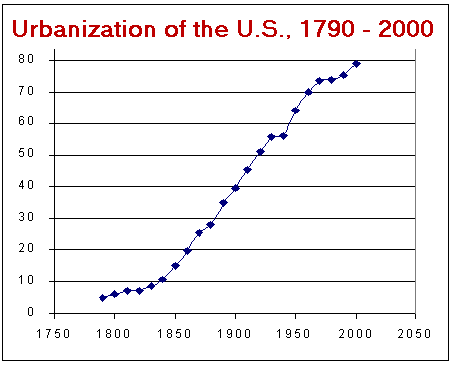
The United States conducted its first census in 1790. At that time the country was overwhelmingly rural: a nation of farmers. Only 5% of the population could be classified as urban. The country's largest city at that time was New York City, and even it had fewer than 50,000 residents. The percentage of the country's population that could be classified as urban increased rather slowly until 1840, rising from 5% in 1790 to 11% in 1840. After that, the percentages rose rapidly, reflecting the spread of the Industrial Revolution and the rise of larger cities in the United States' manufacturing region.
(see chart above)
In 1920, for the first time, the census showed over half of the population to be urban. With a brief delay during the years of the Great Depression, the percentages continued their increase, reaching 74% in 1970. After that, growth slowed somewhat. The United States was up to 79% urban by 2000.
+++++
Foreign-born -- United States vs. Europe
From
Europe Needs a New Identity
http://www.fareedzakaria.com/articles/newsweek/112105.html
Europe Needs a New Identity
http://www.fareedzakaria.com/articles/newsweek/112105.html
Western Europe today has almost as many foreign-born citizens as does the United States. But its countries don't think of themselves as immigrant nations. The centers of society remain tightly knit, insular and largely homogenous.
Theory and practice diverge sharply. Europeans claim to have given up their old national identities, but have they really? France speaks of a republic of values, but scratch beneath the surface and it is a republic of cloistered communities. Other European countries speak of postreligious, postnational identities, but at heart they remain countries where identity is defined by family, community and territory. This is, after all, what so many of us find admirable about Europe. Its communities are rooted in specific places-terroir. People don't move; they give a place a sense of historical continuity. The ties to the land remain deep. But these very traits-seen in those wonderful French movies about the countryside-become deeply oppressive to outsiders struggling to find a place at the table. A recent French study showed that job applicants with "French-sounding names" had 50 times the chance of being interviewed as those with Arab- or African-sounding names.
Einstein's Cartoon Laws of Physics
From
Quantum Trickery: Testing Einstein's Strangest Theory
http://www.nytimes.com/2005/12/27/science/27eins.html
Quantum Trickery: Testing Einstein's Strangest Theory
http://www.nytimes.com/2005/12/27/science/27eins.html
This fall scientists announced that they had put a half dozen beryllium atoms into...the condition of being two diametrically opposed conditions at once, like black and white, up and down, or dead and alive.
These atoms were each spinning clockwise and counterclockwise at the same time. Moreover, like miniature Rockettes they were all doing whatever it was they were doing together, in perfect synchrony. Should one of them realize, like the cartoon character who runs off a cliff and doesn't fall until he looks down, that it is in a metaphysically untenable situation and decide to spin only one way, the rest would instantly fall in line, whether they were across a test tube or across the galaxy.
Tuesday, December 27, 2005
Pork & Plato
Below is info about the book I was trying to remember.
I've also included info from a Web page that had been part of the apparently defunct "ENCYCLOPEDIA OF THE MIDWEST"
It raises a bunch of interesting ideas that relate to our discussion this morning.
The book Robert mentioned is
Sundown Towns: A Hidden Dimension of American Racism
(October 2005)
+++
Helen (Lefkowitz) Horowitz
Culture and the City: Cultural Philanthropy in Chicago from the 1880s to 1917
(The University Press of Kentucky, Lexington, 1976 hardback)
(Univ of Chicago Press, 1989 paperback)
Traces the establishment of many of the great cultural institutions of Chicago, including the Art Institute, the Newberry, the Field Museum, the Chicago Symphony Orchestra, and the University of Chicago.
Her argument was that "Midwestern cultural philanthropy has always combined 'pork and Plato.'"
+++++
ENCYCLOPEDIA OF THE MIDWEST
SECTION 22: PHILANTHROPY AND CIVIC CULTURE
Judith Sealander, Professor of History at Bowling Green State University
THE SECTION
The Philanthropy and Civic Culture section of the Encyclopedia is organized around eight themes providing vehicles for a lively exploration of the nature of Midwestern civic culture and philanthropy.
Community Self-Help in the Midwest
This section will focus on a variety of self-help institutions Midwesterners created from the 1790s through the late twentieth century. From the granges to Ohio Representative Tony Hall's regional "gleaning" associations, through which the poor collected surplus food and other necessities on their own, Midwesterners have prided themselves on a tradition of self-help. Entries in this section will analyze that tradition. Is a reputation for self-sufficiency in the Midwest deserved? What have been the "self-help" traditions of various ethnic and racial groups? Is a culture of Midwestern self-sufficiency in decline in modern America?
"Making a More Perfect World": The Reformist Impulse in Midwestern Civic Culture
This section will range widely–from the famous Midwestern Utopian experiments of the nineteenth century such as Amana and the various Shaker colonies to other efforts to remake society from abolitionism in the nineteenth century to a search for racial justice in the twentieth.
Cultural Philanthropy
In her book Culture and the City, which focused on Chicago, Helen Horowitz has argued that Midwestern cultural philanthropy has always combined "pork and Plato." Is that true? This section will explore what in fact have been the chief characteristics of cultural philanthropy in the region.
Philanthropy and the Creation of Expert Knowledge
American philanthropy has played a major role in organizing systems of knowledge, especially in the twentieth century. In interesting ways, many new kinds of "expertise" and "knowledge" had roots in philanthropy-supported research based in the Midwest—demography, sexuality research, "child study." This section will examine that legacy.
"Institutionalizing Public Spirit": Philanthropy and Midwestern Expectations of Citizenship
The idea of crafting a “perfect” citizenry saw widespread acceptance in many Midwestern areas from the 1920s through 1945. This notion manifested itself in the rise of the Ku Klux Klan in the region and enthusiastic support for the tenets of eugenics. What has been the legacy of the KKK? How did activities such as “Fit Families” contests, so popular in the state of Iowa and Nebraska, shape notions of citizenship and national culture in this period? Until after World War II, Minnesota was more likely to be known for political corruption, civil discord, and high levels of racial prejudice than for tolerance and community-based philanthropy. What changed Minnesota? Many national school reform efforts began in major Midwestern cities. What has contributed to the development of those efforts? This section will explore the shifting and complex nature of citizenship and civic expectations in the Midwest. Have Midwesterners retained notions of the importance of "social capital" in decline elsewhere in modern times?
The World of Midwestern Business Philanthropy
From John H. Patterson’s NCR Corporation to tens of thousands of late-twentieth-century firms Midwestern businesses have contributed to charity. Small and medium-size businesses, over time, have had a much more important philanthropic impact than have the better-known efforts of very large corporations. Much Midwestern philanthropy can be attributed to contributions of small and medium-size businesses. Has that made a difference? What impact have business and Midwestern business culture generally had on philanthropy?
Midwestern Attitudes About Charity to the Poor
Economist Steve Ziliac has used a century's worth of relief roll records from Indianapolis to assess community responses to poverty and the poor. He has seen much more consistency than change in poor relief programs in that city. Is that true for the region? What has been notable about Midwestern responses to poverty? Why have many of the "End of Welfare" initiatives of the late twentieth century begun in the Midwest?
The Community Foundation
The Community Foundation is a Midwestern invention. The Cleveland Foundation, created in 1914, was the nation's first. And the Midwest remains a region where community trusts remain very important. What has been the legacy and impact of community trusts?
Return to Previous Page
I've also included info from a Web page that had been part of the apparently defunct "ENCYCLOPEDIA OF THE MIDWEST"
It raises a bunch of interesting ideas that relate to our discussion this morning.
The book Robert mentioned is
Sundown Towns: A Hidden Dimension of American Racism
(October 2005)
+++
Helen (Lefkowitz) Horowitz
Culture and the City: Cultural Philanthropy in Chicago from the 1880s to 1917
(The University Press of Kentucky, Lexington, 1976 hardback)
(Univ of Chicago Press, 1989 paperback)
Traces the establishment of many of the great cultural institutions of Chicago, including the Art Institute, the Newberry, the Field Museum, the Chicago Symphony Orchestra, and the University of Chicago.
Her argument was that "Midwestern cultural philanthropy has always combined 'pork and Plato.'"
+++++
ENCYCLOPEDIA OF THE MIDWEST
SECTION 22: PHILANTHROPY AND CIVIC CULTURE
Judith Sealander, Professor of History at Bowling Green State University
THE SECTION
The Philanthropy and Civic Culture section of the Encyclopedia is organized around eight themes providing vehicles for a lively exploration of the nature of Midwestern civic culture and philanthropy.
Community Self-Help in the Midwest
This section will focus on a variety of self-help institutions Midwesterners created from the 1790s through the late twentieth century. From the granges to Ohio Representative Tony Hall's regional "gleaning" associations, through which the poor collected surplus food and other necessities on their own, Midwesterners have prided themselves on a tradition of self-help. Entries in this section will analyze that tradition. Is a reputation for self-sufficiency in the Midwest deserved? What have been the "self-help" traditions of various ethnic and racial groups? Is a culture of Midwestern self-sufficiency in decline in modern America?
"Making a More Perfect World": The Reformist Impulse in Midwestern Civic Culture
This section will range widely–from the famous Midwestern Utopian experiments of the nineteenth century such as Amana and the various Shaker colonies to other efforts to remake society from abolitionism in the nineteenth century to a search for racial justice in the twentieth.
Cultural Philanthropy
In her book Culture and the City, which focused on Chicago, Helen Horowitz has argued that Midwestern cultural philanthropy has always combined "pork and Plato." Is that true? This section will explore what in fact have been the chief characteristics of cultural philanthropy in the region.
Philanthropy and the Creation of Expert Knowledge
American philanthropy has played a major role in organizing systems of knowledge, especially in the twentieth century. In interesting ways, many new kinds of "expertise" and "knowledge" had roots in philanthropy-supported research based in the Midwest—demography, sexuality research, "child study." This section will examine that legacy.
"Institutionalizing Public Spirit": Philanthropy and Midwestern Expectations of Citizenship
The idea of crafting a “perfect” citizenry saw widespread acceptance in many Midwestern areas from the 1920s through 1945. This notion manifested itself in the rise of the Ku Klux Klan in the region and enthusiastic support for the tenets of eugenics. What has been the legacy of the KKK? How did activities such as “Fit Families” contests, so popular in the state of Iowa and Nebraska, shape notions of citizenship and national culture in this period? Until after World War II, Minnesota was more likely to be known for political corruption, civil discord, and high levels of racial prejudice than for tolerance and community-based philanthropy. What changed Minnesota? Many national school reform efforts began in major Midwestern cities. What has contributed to the development of those efforts? This section will explore the shifting and complex nature of citizenship and civic expectations in the Midwest. Have Midwesterners retained notions of the importance of "social capital" in decline elsewhere in modern times?
The World of Midwestern Business Philanthropy
From John H. Patterson’s NCR Corporation to tens of thousands of late-twentieth-century firms Midwestern businesses have contributed to charity. Small and medium-size businesses, over time, have had a much more important philanthropic impact than have the better-known efforts of very large corporations. Much Midwestern philanthropy can be attributed to contributions of small and medium-size businesses. Has that made a difference? What impact have business and Midwestern business culture generally had on philanthropy?
Midwestern Attitudes About Charity to the Poor
Economist Steve Ziliac has used a century's worth of relief roll records from Indianapolis to assess community responses to poverty and the poor. He has seen much more consistency than change in poor relief programs in that city. Is that true for the region? What has been notable about Midwestern responses to poverty? Why have many of the "End of Welfare" initiatives of the late twentieth century begun in the Midwest?
The Community Foundation
The Community Foundation is a Midwestern invention. The Cleveland Foundation, created in 1914, was the nation's first. And the Midwest remains a region where community trusts remain very important. What has been the legacy and impact of community trusts?
Return to Previous Page
Tuesday, December 06, 2005
Painful, but important to remember
It is so easy to forget things like these, to put them out of our minds, to stop thinking about them.
But it is important -- essential -- not to forget.
"The guy who runs this building I'm in, emergency management, he's responsible for everything. His mother was trapped in St. Bernard nursing home and every day she called him and said, "Are you coming, son? Is somebody coming?" And he said, "Yeah, Mama, somebody's coming to get you. Somebody's coming to get you on Tuesday. Somebody's coming to get you on Wednesday. Somebody's coming to get you on Thursday. Somebody's coming to get you on Friday." And she drowned Friday night. She drowned "
-- Jefferson Parish President Aaron Broussard, Meet the Press, September 4, 2005
"As I was watching the events on television, watching my husband being burned alive in a building, I would have thought the president would have gotten up and told children: "Please excuse me, but I have something important to attend to." I would hope that we’d have somebody in office that would act like the commander in chief if, God forbid, we’re ever under attack again."
-- Lorie Van Auken, 9/11 widow
China Ventures Southward
From 12-06-2005 Washington Post
China Ventures Southward
In Search of Cheaper Labor, Firms Invest in Vietnam
China Ventures Southward
In Search of Cheaper Labor, Firms Invest in Vietnam
...Much as manufacturers in the United States have transferred jobs to Latin America and just as Western European factories now look to Poland and Hungary, China's modern-day capitalists are increasingly focused on wringing profit from Southeast Asia. They are tapping new markets for sales and farming out work to people willing to labor for less than at home and in even tougher conditions. In a global economy driven by the pursuit of lower costs and fatter profit -- a drive that has led so many multinationals to low-wage China -- Southeast Asia is emerging as China's own version of China....